Product Release
Introducing ByteRover CLI 2.0: Reinvent memory for autonomous agents
We’re excited to announce the release of ByteRover CLI 2.0, a major update that reinvents ByteRover’s memory architecture and expands its capabilities to support autonomous agents such as OpenClaw.
Over the past eight months, our focus has been on memory for coding agents. We designed ByteRover’s memory system to help developer teams manage long-term, persistent contextual knowledge for their agents, making it easy to share, reuse, and version-control that knowledge across teams.
What we’ve learned is that this challenge isn’t limited to code. As AI agents are increasingly deployed end-to-end, persistent knowledge, both within individual agents and across multiple agents, becomes a critical layer of the system. We believe now is the right time to extend these capabilities beyond coding agents.
That’s the problem we’re addressing with ByteRover CLI 2.0.
What we are keeping as our core
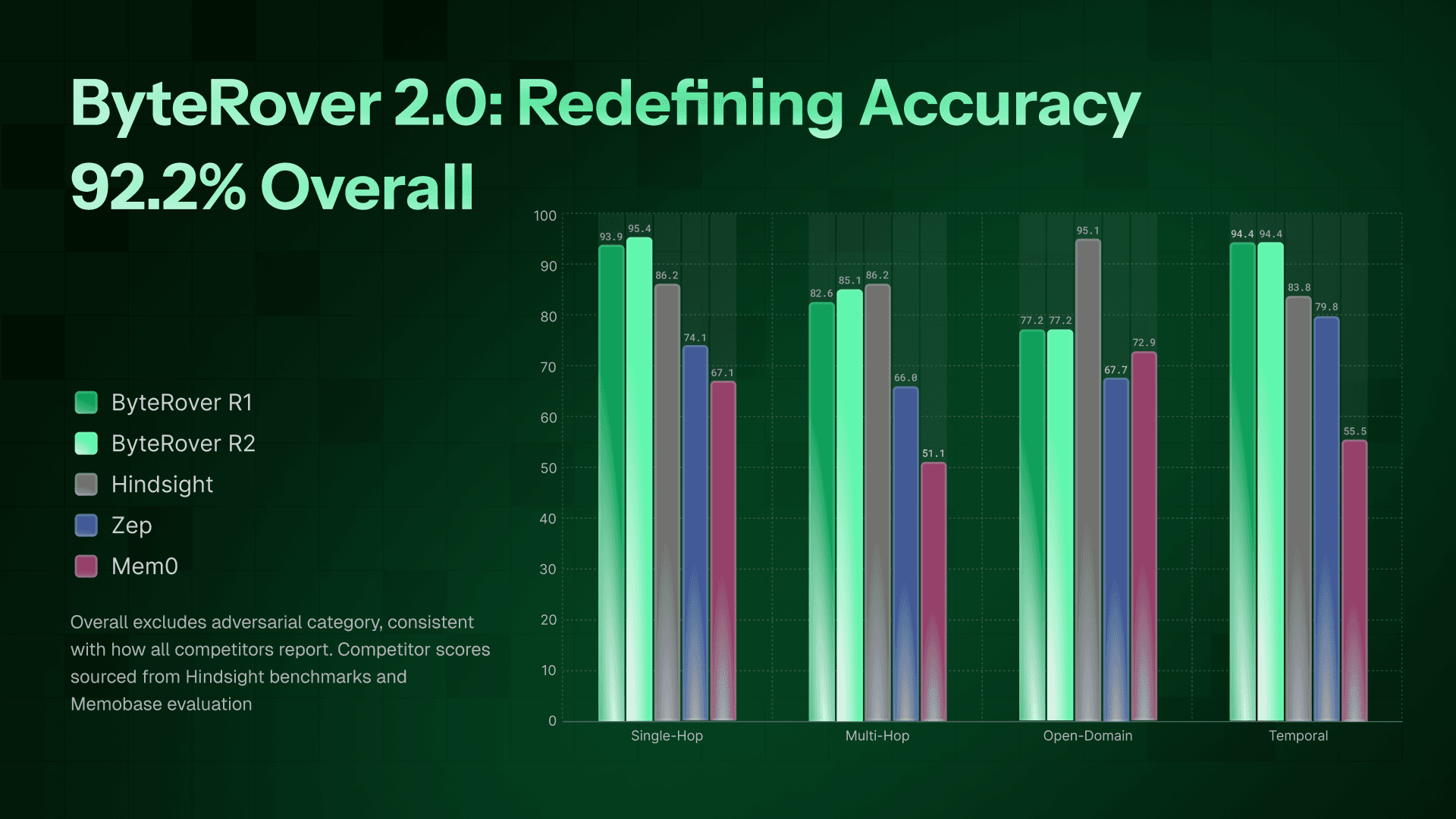
Memory curation, tree structure, agentic file-based search in our core architecture that enables 92.19% retrieval accuracy - highest on the market
→ Learn more about ByteRover's LoCoMo benchmark
Since September 2025, we’ve moved beyond vector-based memory to fundamentally redesign how memory is stored, structured, and retrieved - using a context tree architecture combined with agentic, file-based search.
Most memory systems today store information as a flat list and rely heavily on vector similarity search for retrieval. While vector search is effective at finding semantically similar text, memory is more than similarity. Embeddings don’t capture why a piece of knowledge matters, how it connects to other knowledge, or whether it’s still relevant or valid.
ByteRover takes a different approach. Instead of treating memory as a passive store, we apply LLM-enabled curation upfront to actively structure and organize knowledge before storage. A ByteRover agent intelligently curates, synthesizes, and arranges memory into a context tree organized as modular .md files with a clear hierarchy (domain → topic → subtopic).
Retrieval is then performed by an agent that searches directly across these structured knowledge files, enabling richer context, better reasoning, and more reliable recall than similarity-based methods alone.
This is what drives our benchmark results: overall 92.19% highest on the market.
Single-hop recall: 95.4%. When a fact is cleanly curated in the context tree upfront, retrieving it later is near-trivial. The agent knows exactly where to look.
Temporal reasoning: 94.4%. Player like Zep was purpose-built for temporal reasoning via knowledge graphs and reached 79.8%. ByteRover beats it by 14.6 points, not through a specialized graph structure, but because session order and timestamps are captured during the curation.
Multi-hop retrieval: 85.1%. This is where the gap between architectures is widest. Multi-hop questions require connecting facts across sessions. Flat similarity search struggles here because there's no structure to traverse. The context tree makes cross-session traversal efficient by design which is why our multi-hop score pulls furthest ahead of competitors.
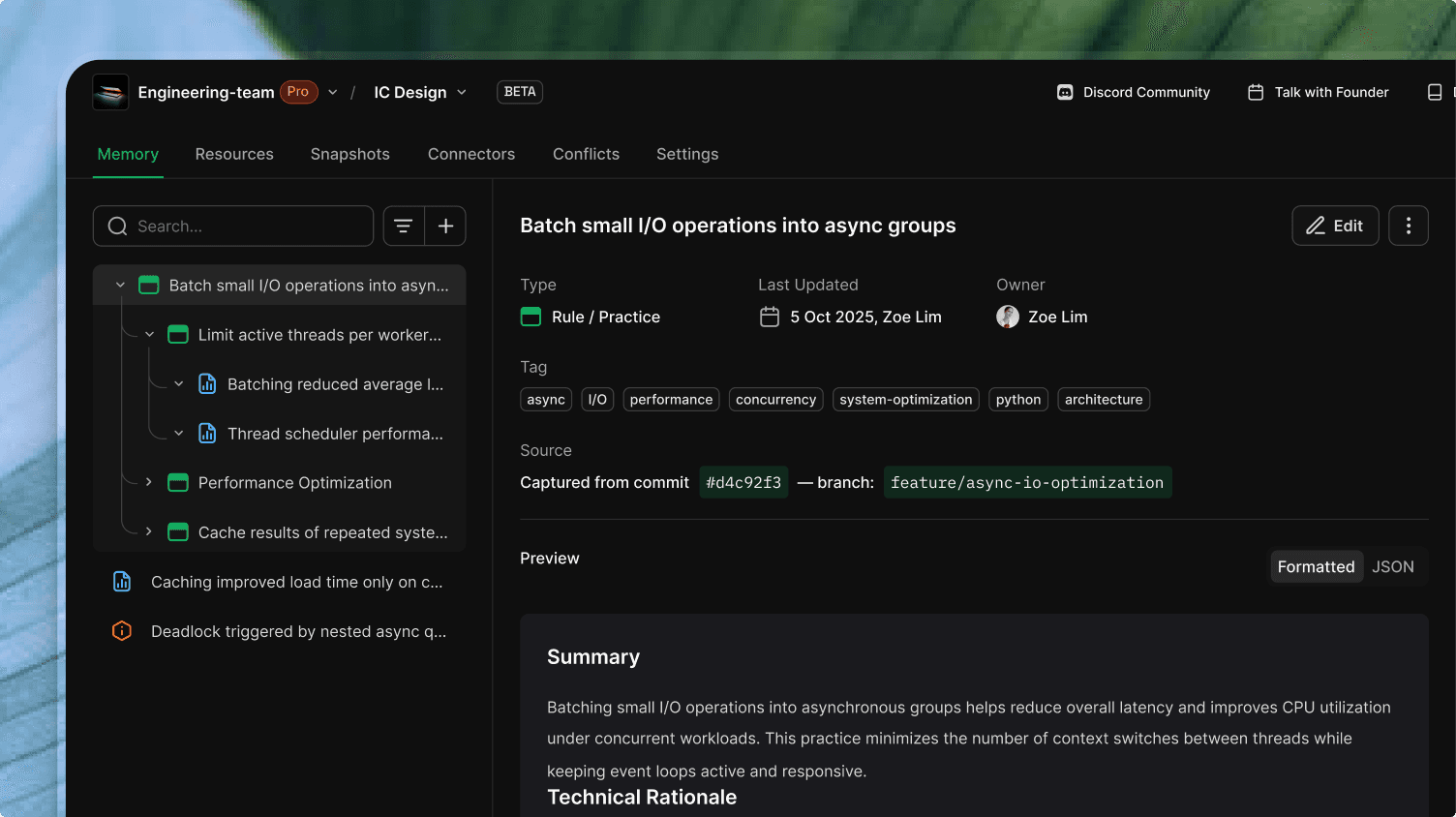
Below is an example context tree of memories of .brv folder
Memory portability on cloud with version control & management
Memory workspace on cloud with version control and team management capability have been the highlights of what we have been building for coding agents. Developers in our community love using our cloud-based webapp to have 100% control over how their memories are organized, and shared across team members. Now we extend it to more agents like OpenClaw. With ByteRover’s cloud-based platform, teams can sync memory on cloud, edit and version control it.
Work with any model and provider
You can power ByteRover with your own LLM using API key, allowing you to leverage your existing agentic stack where you have full control over model choices, cost and observability.
What is new
Support for OpenClaw memory
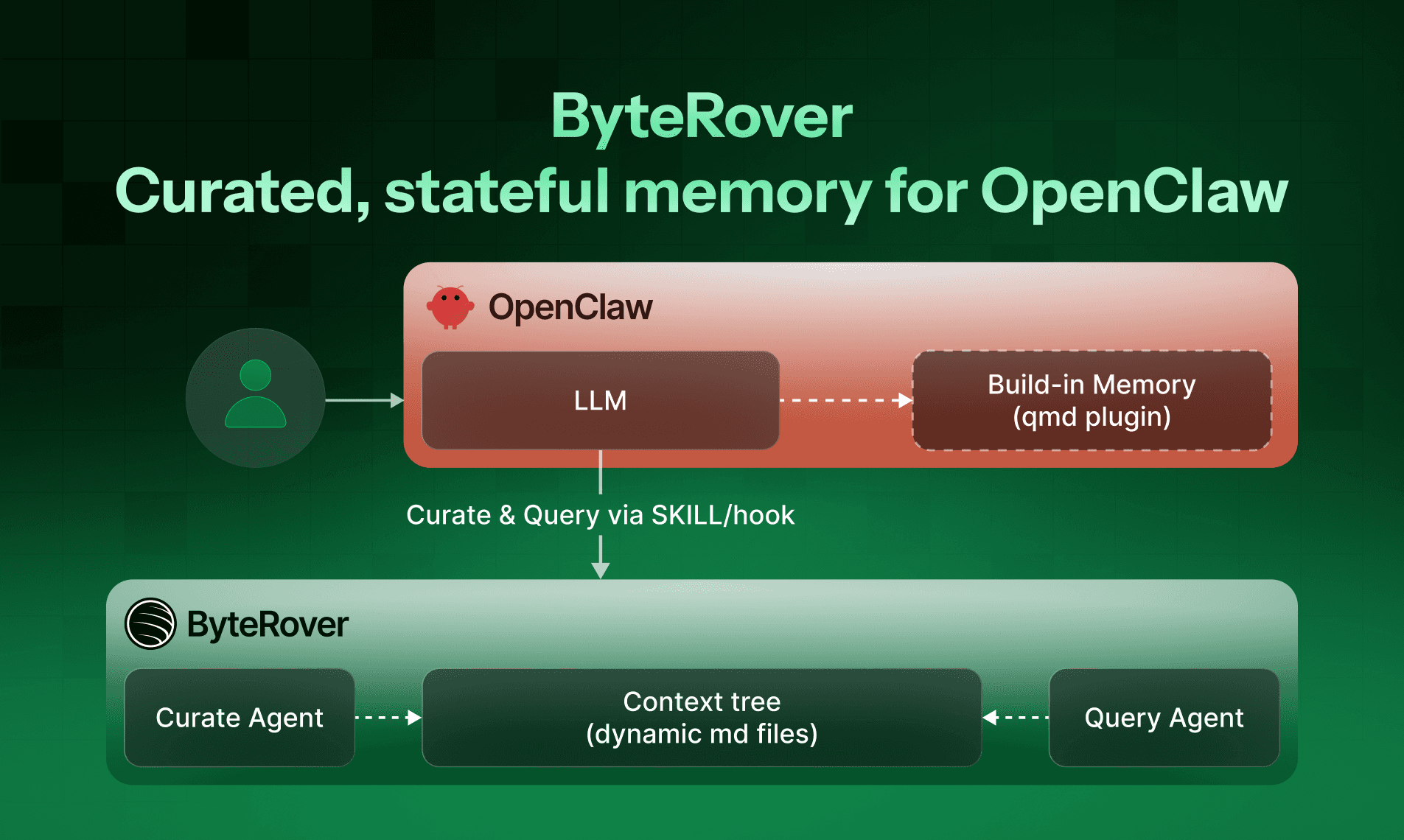
We do not stop at building our memory system for coding agents like Cursor, Codex, ClaudeCode, we expand our integrations to agent like OpenClaw. ByteRover adds curation capability to memory on OpenClaw, makes memory portable on cloud for management, and version control across team member, and across agents.
→ Read more about ByteRover x OpenClaw.
Fully local support
Before, when you deploy ByteRover, it required authentication, a team, and a space registration on our web-app to be able to get started with ByteRover CLI 2.0. Now you just need to install, cd to your project, and get started.
Optimize retrieval speed, accuracy and token usage
ByteRover now applies file-based search approach through a tiered retrieval system: cache lookup → full-text search → LLM-powered search only when necessary.
By doing this, we optimize the speed of retrieval without sacrificing accuracy. In fact, by trying to get the minimum required context in the most direct path, sometimes without the need of LLM, is the fundamental for better accuracy as the context window is less polluted.
→ Learn more about retrieval in our architecture deep dive.
ByteRover Skill/Memory Community Hub
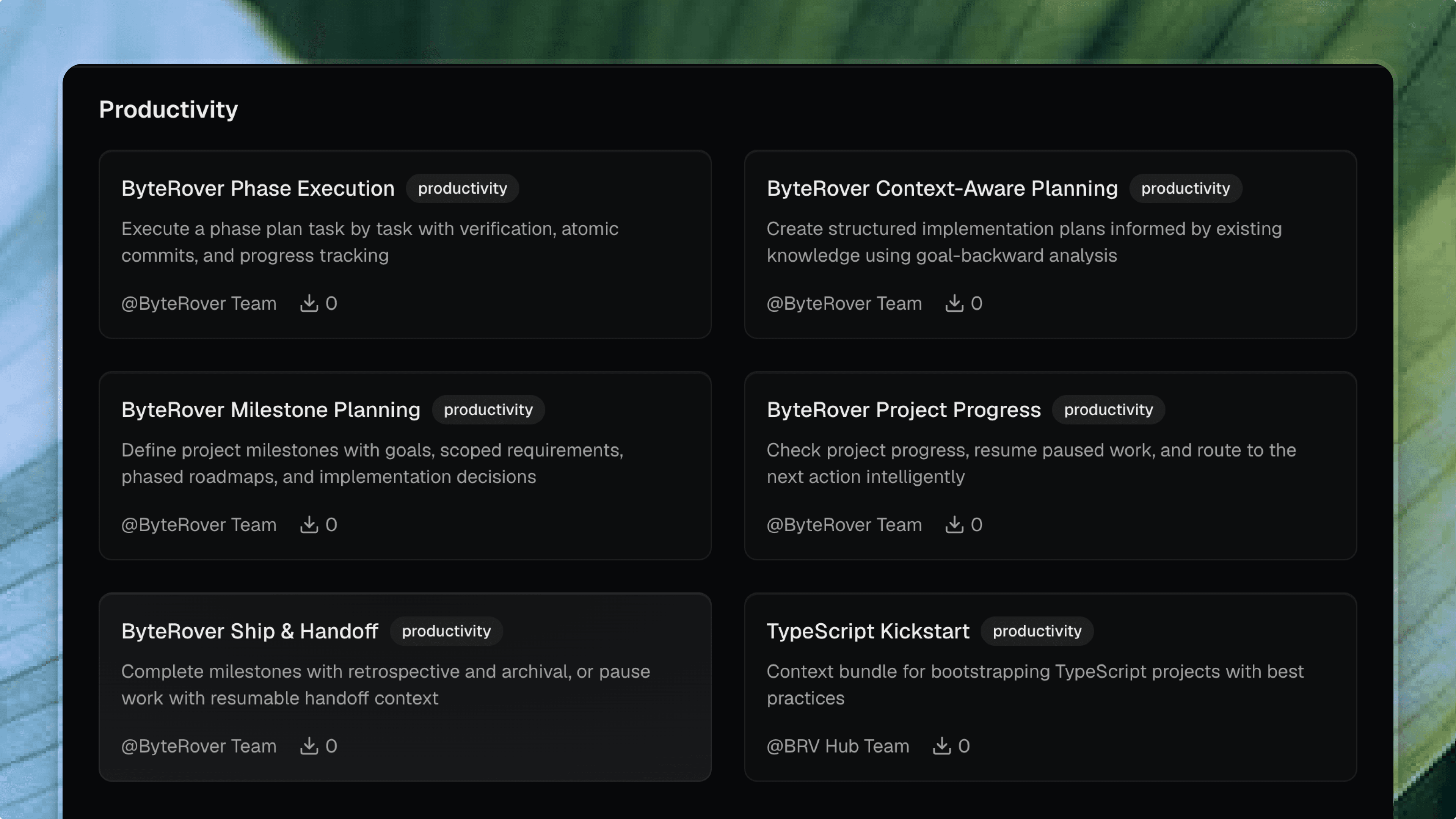
With the 2.0 release, we’re introducing the ByteRover Community Hub.
The Hub is a shared space where you can upload and discover ByteRover skills (onboard, plan, explore, review, and more) as well as memory bundles (such as typescript-kickstart) to use directly with ByteRover.
One recurring challenge we see when people try to leverage autonomous agents is figuring out the right agentic setup for their workflow—quickly. This challenge exists both for proprietary workflows within specialized teams and for common workflows used across industries.
That’s why we introduced agent skills and sub-agents, and it’s also why we’re launching ByteRover Community Hub: a place where the community can share, discover, and reuse proven knowledge trees and agent setups tailored to real workflows.
In the coming weeks, we’ll be doubling down on enabling both our community and internal team to contribute high-quality skills and bundles—so you can complete specific workflows faster and more effectively with ByteRover.
Get started now
ByteRover CLI 2.0 is available now.
👉 Install ByteRover CLI:
curl -fsSL https://www.byterover.dev/install.sh | sh
What we are keeping as our core
Memory curation, tree structure, agentic file-based search in our core architecture that enables 92.19% retrieval accuracy - highest on the market
→ Learn more about ByteRover's LoCoMo benchmark
Since September 2025, we’ve moved beyond vector-based memory to fundamentally redesign how memory is stored, structured, and retrieved - using a context tree architecture combined with agentic, file-based search.
Most memory systems today store information as a flat list and rely heavily on vector similarity search for retrieval. While vector search is effective at finding semantically similar text, memory is more than similarity. Embeddings don’t capture why a piece of knowledge matters, how it connects to other knowledge, or whether it’s still relevant or valid.
ByteRover takes a different approach. Instead of treating memory as a passive store, we apply LLM-enabled curation upfront to actively structure and organize knowledge before storage. A ByteRover agent intelligently curates, synthesizes, and arranges memory into a context tree organized as modular .md files with a clear hierarchy (domain → topic → subtopic).
Retrieval is then performed by an agent that searches directly across these structured knowledge files, enabling richer context, better reasoning, and more reliable recall than similarity-based methods alone.
This is what drives our benchmark results: overall 92.19% highest on the market.
Single-hop recall: 95.4%. When a fact is cleanly curated in the context tree upfront, retrieving it later is near-trivial. The agent knows exactly where to look.
Temporal reasoning: 94.4%. Player like Zep was purpose-built for temporal reasoning via knowledge graphs and reached 79.8%. ByteRover beats it by 14.6 points, not through a specialized graph structure, but because session order and timestamps are captured during the curation.
Multi-hop retrieval: 85.1%. This is where the gap between architectures is widest. Multi-hop questions require connecting facts across sessions. Flat similarity search struggles here because there's no structure to traverse. The context tree makes cross-session traversal efficient by design which is why our multi-hop score pulls furthest ahead of competitors.
Below is an example context tree of memories of .brv folder
Memory portability on cloud with version control & management
Memory workspace on cloud with version control and team management capability have been the highlights of what we have been building for coding agents. Developers in our community love using our cloud-based webapp to have 100% control over how their memories are organized, and shared across team members. Now we extend it to more agents like OpenClaw. With ByteRover’s cloud-based platform, teams can sync memory on cloud, edit and version control it.
Work with any model and provider
You can power ByteRover with your own LLM using API key, allowing you to leverage your existing agentic stack where you have full control over model choices, cost and observability.
What is new
Support for OpenClaw memory
We do not stop at building our memory system for coding agents like Cursor, Codex, ClaudeCode, we expand our integrations to agent like OpenClaw. ByteRover adds curation capability to memory on OpenClaw, makes memory portable on cloud for management, and version control across team member, and across agents.
→ Read more about ByteRover x OpenClaw.
Fully local support
Before, when you deploy ByteRover, it required authentication, a team, and a space registration on our web-app to be able to get started with ByteRover CLI 2.0. Now you just need to install, cd to your project, and get started.
Optimize retrieval speed, accuracy and token usage
ByteRover now applies file-based search approach through a tiered retrieval system: cache lookup → full-text search → LLM-powered search only when necessary.
By doing this, we optimize the speed of retrieval without sacrificing accuracy. In fact, by trying to get the minimum required context in the most direct path, sometimes without the need of LLM, is the fundamental for better accuracy as the context window is less polluted.
→ Learn more about retrieval in our architecture deep dive.
ByteRover Skill/Memory Community Hub
With the 2.0 release, we’re introducing the ByteRover Community Hub.
The Hub is a shared space where you can upload and discover ByteRover skills (onboard, plan, explore, review, and more) as well as memory bundles (such as typescript-kickstart) to use directly with ByteRover.
One recurring challenge we see when people try to leverage autonomous agents is figuring out the right agentic setup for their workflow—quickly. This challenge exists both for proprietary workflows within specialized teams and for common workflows used across industries.
That’s why we introduced agent skills and sub-agents, and it’s also why we’re launching ByteRover Community Hub: a place where the community can share, discover, and reuse proven knowledge trees and agent setups tailored to real workflows.
In the coming weeks, we’ll be doubling down on enabling both our community and internal team to contribute high-quality skills and bundles—so you can complete specific workflows faster and more effectively with ByteRover.
Get started now
ByteRover CLI 2.0 is available now.
👉 Install ByteRover CLI:
curl -fsSL https://www.byterover.dev/install.sh | sh
What we are keeping as our core
Memory curation, tree structure, agentic file-based search in our core architecture that enables 92.19% retrieval accuracy - highest on the market
→ Learn more about ByteRover's LoCoMo benchmark
Since September 2025, we’ve moved beyond vector-based memory to fundamentally redesign how memory is stored, structured, and retrieved - using a context tree architecture combined with agentic, file-based search.
Most memory systems today store information as a flat list and rely heavily on vector similarity search for retrieval. While vector search is effective at finding semantically similar text, memory is more than similarity. Embeddings don’t capture why a piece of knowledge matters, how it connects to other knowledge, or whether it’s still relevant or valid.
ByteRover takes a different approach. Instead of treating memory as a passive store, we apply LLM-enabled curation upfront to actively structure and organize knowledge before storage. A ByteRover agent intelligently curates, synthesizes, and arranges memory into a context tree organized as modular .md files with a clear hierarchy (domain → topic → subtopic).
Retrieval is then performed by an agent that searches directly across these structured knowledge files, enabling richer context, better reasoning, and more reliable recall than similarity-based methods alone.
This is what drives our benchmark results: overall 92.19% highest on the market.
Single-hop recall: 95.4%. When a fact is cleanly curated in the context tree upfront, retrieving it later is near-trivial. The agent knows exactly where to look.
Temporal reasoning: 94.4%. Player like Zep was purpose-built for temporal reasoning via knowledge graphs and reached 79.8%. ByteRover beats it by 14.6 points, not through a specialized graph structure, but because session order and timestamps are captured during the curation.
Multi-hop retrieval: 85.1%. This is where the gap between architectures is widest. Multi-hop questions require connecting facts across sessions. Flat similarity search struggles here because there's no structure to traverse. The context tree makes cross-session traversal efficient by design which is why our multi-hop score pulls furthest ahead of competitors.
Below is an example context tree of memories of .brv folder
Memory portability on cloud with version control & management
Memory workspace on cloud with version control and team management capability have been the highlights of what we have been building for coding agents. Developers in our community love using our cloud-based webapp to have 100% control over how their memories are organized, and shared across team members. Now we extend it to more agents like OpenClaw. With ByteRover’s cloud-based platform, teams can sync memory on cloud, edit and version control it.
Work with any model and provider
You can power ByteRover with your own LLM using API key, allowing you to leverage your existing agentic stack where you have full control over model choices, cost and observability.
What is new
Support for OpenClaw memory
We do not stop at building our memory system for coding agents like Cursor, Codex, ClaudeCode, we expand our integrations to agent like OpenClaw. ByteRover adds curation capability to memory on OpenClaw, makes memory portable on cloud for management, and version control across team member, and across agents.
→ Read more about ByteRover x OpenClaw.
Fully local support
Before, when you deploy ByteRover, it required authentication, a team, and a space registration on our web-app to be able to get started with ByteRover CLI 2.0. Now you just need to install, cd to your project, and get started.
Optimize retrieval speed, accuracy and token usage
ByteRover now applies file-based search approach through a tiered retrieval system: cache lookup → full-text search → LLM-powered search only when necessary.
By doing this, we optimize the speed of retrieval without sacrificing accuracy. In fact, by trying to get the minimum required context in the most direct path, sometimes without the need of LLM, is the fundamental for better accuracy as the context window is less polluted.
→ Learn more about retrieval in our architecture deep dive.
ByteRover Skill/Memory Community Hub
With the 2.0 release, we’re introducing the ByteRover Community Hub.
The Hub is a shared space where you can upload and discover ByteRover skills (onboard, plan, explore, review, and more) as well as memory bundles (such as typescript-kickstart) to use directly with ByteRover.
One recurring challenge we see when people try to leverage autonomous agents is figuring out the right agentic setup for their workflow—quickly. This challenge exists both for proprietary workflows within specialized teams and for common workflows used across industries.
That’s why we introduced agent skills and sub-agents, and it’s also why we’re launching ByteRover Community Hub: a place where the community can share, discover, and reuse proven knowledge trees and agent setups tailored to real workflows.
In the coming weeks, we’ll be doubling down on enabling both our community and internal team to contribute high-quality skills and bundles—so you can complete specific workflows faster and more effectively with ByteRover.
Get started now
ByteRover CLI 2.0 is available now.
👉 Install ByteRover CLI:
curl -fsSL https://www.byterover.dev/install.sh | sh